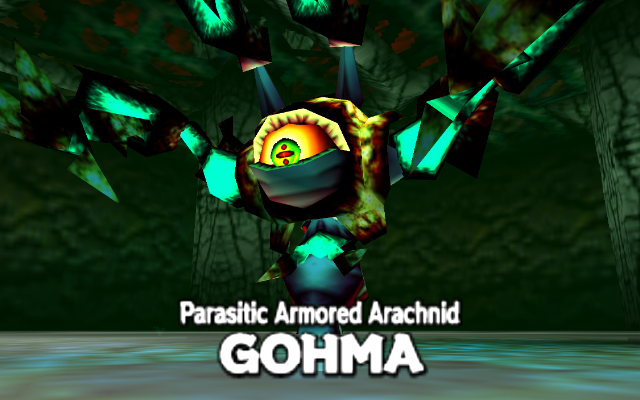
There are few moments in video game history quite as satisfying as defeating your first boss in The Legend of Zelda: Ocarina of Time. You’ve navigated the mysterious interior of the Great Deku Tree, solved a few puzzles, learned the fundamentals of combat, and finally confronted the monstrous Queen Gohma. With a well-placed slingshot pellet and a few enthusiastic swings of your sword, the creature falls, and another young hero takes his first steps toward saving Hyrule.
It’s a wonderful moment. Unless, of course, you’re Queen Gohma.
While millions of players have spent nearly three decades celebrating their first great victory, remarkably few have considered the other side of this encounter. And the more closely one examines the circumstances, the more troubling the entire affair becomes.
Consider, for a moment, the life of Queen Gohma.
She’s a mother. A working mother, no less. She has children to raise, responsibilities to fulfill, and a position to maintain within Ganondorf’s expanding organization. Whatever one’s feelings about her employer’s long-term political ambitions, Gohma herself appears to have been assigned a relatively straightforward task: occupy the Great Deku Tree and carry out the curse placed upon him.
Is it glamorous work? Certainly not. The accommodations are damp, the lighting is terrible, and the building is quite literally alive. But a job is a job.
We know little about Ganondorf’s compensation structure. Whether his servants receive healthcare, retirement contributions, or even the occasional paid holiday remains unclear. But the economic realities of raising multiple children cannot simply be ignored because those children happen to be enormous, aggressive arthropods.
Gohma has mouths to feed. Quite a few of them, in fact.
And then, one perfectly ordinary day, a child with a sword arrives.
Not a representative of the local authorities. Not a diplomatic envoy. Not even an unusually determined building inspector. A child.
A young Kokiri boy, undertaking his very first assignment, enters the premises armed with a sword, a wooden shield, and an impressive collection of objects acquired from the surrounding environment. He has been told that something terrible is happening inside the Great Deku Tree. He has been instructed to put a stop to it. And, being a video game protagonist, he never once considers requesting a second opinion.
There is something wonderfully reminiscent here of Monty Python and the Holy Grail, particularly the infamous wedding scene in which Sir Lancelot charges into a castle and begins enthusiastically slaughtering its occupants under the impression that he is conducting a heroic rescue. The situation, as it turns out, is rather more complicated than he imagined. But by the time anyone has an opportunity to explain, the damage is considerable.
Link approaches his first dungeon with much the same uncomplicated confidence. There is a problem. There are monsters. He has a sword. The matter practically resolves itself.
Unfortunately, many of those monsters are Gohma’s children.
Throughout the Great Deku Tree, the young adventurer encounters Gohma Larvae and dispatches them as obstacles to be overcome. Their presence is treated as evidence of an infestation rather than what it might equally represent: a family living in the only home they have ever known.
We never learn their names. We never discover whether any of them had ambitions beyond the family business. Perhaps one dreamed of leaving the tree and opening a small establishment in Castle Town. Perhaps another had shown an early aptitude for music.
We’ll never know.
Their lives end beneath the blade of a boy who, until very recently, was largely occupied with finding a sword and gathering enough rupees to purchase a shield.
Eventually, Link arrives at the mother’s chamber.
Queen Gohma is an intimidating creature, certainly. Her enormous eye, armored body, and numerous legs do little to encourage friendly conversation. But appearances, as any thoughtful observer should recognize, are not a reliable measure of character.
The confrontation begins when Link looks upward and encounters her gaze.
Now, Gohma could reasonably be expected to defend herself. A stranger has entered her territory, destroyed members of her family, and arrived carrying a weapon. Under the circumstances, some degree of hostility would hardly be surprising.
Yet consider what happens during the encounter. Gohma repeatedly climbs the walls and retreats to the ceiling.
To the player, this is simply a combat mechanic. The boss is repositioning herself, preparing another attack, and creating an opportunity for the hero to demonstrate his newly acquired skills. But viewed from another perspective, the behavior is rather revealing.
Here is a creature attempting to put considerable distance between herself and an armed intruder. Link has a sword. Gohma has access to the ceiling. The obvious solution would appear to be allowing everyone a few moments to reconsider their choices.
Perhaps the boy could return to the Deku Tree and ask whether there might be some alternative arrangement. Perhaps Gohma could contact her supervisor and request reassignment.
There are possibilities.
Unfortunately, Link has a slingshot.
And the moment Gohma’s enormous eye becomes visible from above, the boy enthusiastically demonstrates that vertical separation is not, in fact, an effective conflict-resolution strategy.
A pellet strikes her eye. She tumbles helplessly to the ground. The sword comes out again.
One can only imagine Gohma’s growing frustration. She has endured the destruction of her children, the invasion of her workplace, and the arrival of a heavily armed juvenile who seems entirely uninterested in discussing the matter.
Now he is shooting her in the eye. Repeatedly.
Eventually, the inevitable happens. Queen Gohma falls.
The great monster collapses, her body dissolves, and the young hero is rewarded with a Heart Container. A portal appears, conveniently transporting him away from the scene.
There will be no questions asked. No incident report. No examination of whether the use of force was proportionate to the threat. The boy has defeated his first boss. Congratulations are apparently in order.
Of course, the conventional interpretation is not without merit. Ganondorf’s curse is destroying the Great Deku Tree, and Link has been summoned to confront the source of that suffering. Gohma is hardly an innocent woodland resident who happened to wander into the wrong neighborhood.
But that is precisely what makes the question interesting.
Video games are remarkably effective at establishing moral certainty through perspective. We know Link is the hero because the story tells us so, because the music assures us of his courage, and because the creatures standing between him and his objectives are designated enemies.
We rarely ask what those creatures believe they are doing. Or whether they have families. Or whether the enormous spider waiting at the end of the dungeon might simply be trying to finish her shift and get home.
None of this diminishes the brilliance of Ocarina of Time. If anything, it demonstrates something wonderful about enduring works of entertainment: even decades later, they can invite us to reconsider familiar experiences from unexpected angles.
Queen Gohma was designed to be a memorable first boss, and she succeeds magnificently. But perhaps there is room, somewhere amid the celebrations of Link’s courage, for a little sympathy.
A mother went to work. Her children were killed. An armed stranger entered her chamber, pursued her to the ceiling, and repeatedly shot her in the eye until she died.
The stranger received a prize. The world called him a hero.
And for Queen Gohma, there were no flowers, no memorial, and no moment of silence.
No tears for Gohma.